
Hello, I’m Veronica
The sky is not completely dark at night. Were the sky absolutely dark, one would not be able to see the silhouette of an object against the sky.


-
Lovely Are Thy Branches
Christmas prep – at our house – starts the weekend after Thanksgiving and goes all the way thru December 24th. I like to think it’s deliberate – taking a month or more to drag out the “getting ready”. Some years we’re rushed but the house always seems to get decorated, the cookies baked, the presents wrapped, the cards sent, and the food shopped. There’s always a dinner reservation on Christmas Eve; always room in the pews at the late, late church service. But what if – some year – we dispensed with all of that prep? December 25th would still come, of course. But it wouldn’t be Christmas, unless we had a tree.

I can’t think of a single Christmas in my fifty-plus years when we haven’t had a fully-decorated tree. Whether the lights or the ornaments or the angel on top, the tree to me is the ultimate expression of the holiday season. Christmas trees have been standing since the 1500’s (proved by a sculpted image at an estate in France). In the late 1700’s, Christmas trees hopped the pond to America.
My affection for decorated trees dates to my early childhood in Los Angeles. Late on a mid-December day, my mother would pack my brothers and I into the station wagon, drive downtown, and meet up with my father after work. Near his office, hundreds of Christmas trees were being unloaded from boxcars in the train yard; some of them still fresh with snow. You may prefer the convenience of your neighborhood tree lot, but sorry; nothing beats the childhood nostalgia of picking a tree straight from a boxcar.

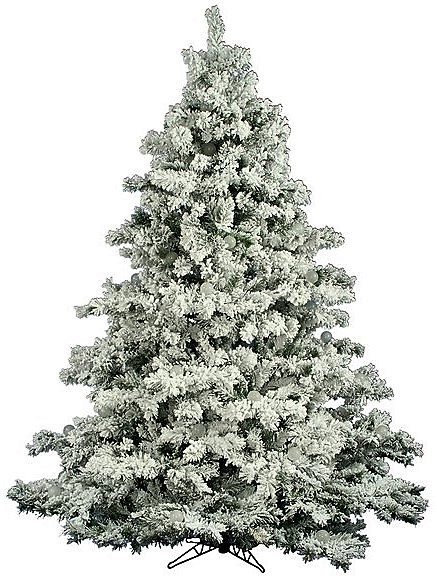
Flocked tree Since we never had snow in Los Angeles, we often had our Christmas tree “flocked” before taking it home. Flocking means placing a tree on a spinning stand and covering it with a product I can only describe as spray Styrofoam. As tacky as that sounds, the result is remarkably “snow-like”. Flocking even comes in colors (but I never understood why anyone would want pink or green snow).
As for tree ornaments, they’ve been around since Christmas trees themselves. What were once apples, candy canes, and pastries (elegantly simple, if you ask me) have now evolved into everything imaginable. On my childhood tree, I only remember those delicate, shiny, colored balls and bells; the ones which shattered on the slightest impact. We also had tinsel; endless garlands of thin strips of colored foil, and tinsel is a great word, don’t you think?

Christmas lights became a staple of tree decor in 1882, when an Edison Electric VP first added them to his family tree. The lights on my childhood tree – the multi-colored “C9” incandescent standard of the time – were connected to an illuminated star at the very top. A few strands contained transparent-colored “blinkies”. In hindsight, blinky lights sound as tacky as flocking but somehow, they worked alongside everything else on the tree.
Here’s a little Christmas tree trivia for you. The carol, O’ Christmas Tree, is sometimes sung in German, starting with “O’ Tannenbaum, O’ Tannenbaum…”. Guess what? You’re actually singing, “O’ Fir Tree, O’ Fir Tree…”. If you’re looking for the correct translation, go with, “O’ Weihnachtsbaum…” instead.

Christmon tree One more bit of trivia. If you find a tree decorated with nothing but white and gold Christian symbols, you’re looking at a Christmon tree. Blend the sounds and meanings of “Christ” and “monogram” and you come up with the portmanteau “Christmon”. Sounds (and looks) beautiful to me.
I don’t think I’ll ever have to worry about finding a Christmas tree. Over 35 million are produced in the U.S. each year; another 60 million in Europe. The average cost of a live-cut Christmas tree last year was $73, and that includes a lot of really tall ones. Someday, I won’t be able to erect a nine or ten-foot tree in my living room anymore. No worries; I’ll just go with a table-top instead (a “Charlie Brown”, if you will). Her branches will be just as lovely.
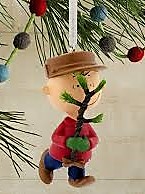
Some content sourced from Wikipedia, “the free encyclopedia”.
-
Dusting Off Dumbo
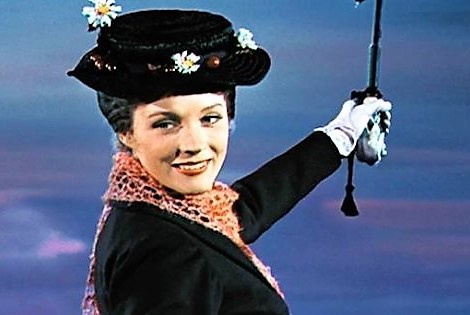
In March, Disney will release a remake of the children’s classic “Dumbo”, almost eighty years after the original. An intriguing story (Tim Burton directs), and the wonders of computer animation suggest the new version will be pretty good; standing on its own the way Jim Carrey managed with his version of the Grinch. “Mary Poppins” also Returns next week after a fifty-year absence. Emily Blunt looks supercalifragilistic in the previews, but with all due respect, there’s only one Mary Poppins and her name is Julie Andrews (there is also only one Maria Von Trapp and her name is also Julie Andrews).

Movie remakes are blog-worthy, but that’s not my mission today. I’m here to talk about Dumbo. Even though his modern-day movie doesn’t come out for a few more months, you’ll find him at any one of the six Disney parks. He’ll fly you in dizzy circles with his big ears and colorful cap; as happy an elephant as he’s ever been. But on closer inspection, you may find your Dumbo needs a little dusting off. That grey may be his (plastic) skin perhaps, but – brace yourself – it may also be the scattered remains of deceased Disney devotees. Apparently some souls choose to be interred in an urn known as The Happiest Place On Earth.
Okay, I know some of you were anticipating a jolly-holiday post this time of year, with visions of chestnuts roasting on an open fire (“pop! pop! pop!”) or a “Baby It’s Cold Outside” fire (romantic embers) but sorry; today we’re talking about a cremation fire. Doesn’t the topic make you just a little curious? Did you know for instance, we humans spread our ashes (or I should say, have our ashes spread) at sea, in woodland groves, into volcanoes, over sports stadiums and on golf courses, and yes – all over the Disney parks, but “at sea” is the only legal option on the list? Or, did you know, if you spread an entire urn’s worth, you’re talking about five pounds of ashes? Not exactly a spoonful of sugar, Mary.

I never knew Disney had this sort of problem in its parks (although at The Happiest Places On Earth, there are no “problems”). Scattered ashes are reported at least once a month. Disney handles these incidents the way they do other “real-world” stuff: with complete discretion. First, an employee notices said “pixie dust” (maybe with help from Tinker Bell?). Then a “HEPA” text – high-efficiency particulate air – is sent to maintenance, because that’s the kind of vacuum you’re gonna need. Then the ride or area of the park is closed off and the deceased is sucked up “spit-spot”. You can almost see the maintenance guy whistling while he works.

HEPA vac Scattering ashes (other than at-sea) is a misdemeanor, but in true Disney fashion no charges are pressed if you’re caught. Instead, your mouse ears are removed and you’re escorted out the nearest gates, back to the real world. Any patrons inconvenienced by your actions get reimbursed with a Fast Pass or a store voucher. Having said that, plan on a few extra minutes getting screened at the entry gates. Besides knives, bombs, and alcohol, they’re looking for urns. Or, in the backpacks of the more determined: plastic pill bottles and makeup compacts.

Disney’s Dumbo ride is a common place to scatter ashes (specifically, the moat under the flying elephants), as is Cinderella’s Castle (flowerbeds) and It’s A Small World (anywhere near the delirious singing dolls) but where do most scatterings take place? Why, the Haunted Mansion of course. It’s the only truly morbid location at Disney. As your “ghost host” says over and over, “we have 999 happy haunts here, but there’s room for 1,000 – any volunteers?” I guess some people take their ghost host seriously.

On a related topic, several years ago Disney sold personalized hexagonal pavers at its Florida park. You could put anything you wanted on the tiles, except the words “In Memory Of…” Why? Disney didn’t want people to have death on their minds at The Happiest Place On Earth. As Mary Poppins would say, they’re just trying to be practically perfect in every way. But clearly, some people have death on their minds anyway. Or at least, ashes in their backpacks.
Some content sourced from the Wall Street Journal article, “Disney World’s Big Secret…”.
-
Cashing Out
Yesterday I picked up a few items for my mother-in-law, who seems to restrict her driving to the nearby grocery store. After dropping off the purchases at her house, I was reimbursed – rounding up – with a crisp, new, twenty-dollar bill. That bill went straight into my wallet, nestled alongside a couple of paper receipts. But on the drive home I thought to myself, “What am I going to do with twenty dollars?” Not the money, mind you – the bill.

For many of us, this is what it’s come to: cash is a nuisance instead of a convenience. Use that twenty-dollar bill for a purchase and what do you get in return? “Change” – more bills than you had in the first place (and a few of those little round coin thingy’s). It’s the modern-day definition of “cash flow problem”. The coins go into the car “ashtray” (what’s that?) to gather dust. The bills go into the wallet or purse, where they take up more real estate than they deserve.
Speaking of wallets, the contents of mine have been reduced to a driver’s license, two credit cards, a bank card, and a (paper) insurance card. Even if my wallet had a “billfold” pocket, there wouldn’t be anything in it. You could say I choose to be strapped for cash. Instead, my phone slowly absorbs my wallet: payment apps, photos, and ID cards; all formerly parked behind the leather inside my front pants pocket.

Of course, I’m not alone. As the table suggests (from the Wall Street Journal article Should We Move To a Mostly Cashless Society?) we’re using other means to defray our expenses. Cash and checks, please step aside for the more popular debit, credit, and electronic alternatives. Note the table is already three years old, so it’s safe to say “Electronic” is an even taller column today. I know it’s been years since my kids wrote a check (if they ever did). Their data-driven world prefers Venmo, Apple and Google Pay, PayPal, and the like.


How about a couple of surveys to support the cash-is-no-longer-king society we live in? The first – 2,000 respondents (smartphone owners) – says they conduct more transactions with their phone than they do with their cash. The second claims four in ten merchants will soon take payment through “digital wallet” apps (if they don’t already). Stack and rack those bills, people; cash is officially old-school.

One more data-point for you. This survey shows how much (or how little) cash we carry around these days. The age range of the 2,000 respondents is 19-71. I’ll bet my $20 the 71-year-old’s lean toward the yellow ($21-$50) while the phone-gripping teens lean toward the blue ($10 or less). Frankly, I think there should be a fourth color for $0.
In defense of greenbacks, I still come up with two reasons why I occasionally need cash on hand. The first: tips for on-the-spot services (i.e. rental car shuttles). Perhaps one day Avis will include tipping in its app – like Starbucks does – but for now it’s still gotta be cash. The second reason: the needy – spontaneous gifting for those street-corner-dwellers (especially this time of year). Without cash, I’ve got nothing to give.
No surprise, both of my reasons are included in the article 7 Reasons You’ll Always Need Cash The other five? Small-business purchases (i.e. farmer’s markets or lemonade stands); “managing a tight budget” (more of a strategy than a reason); “when technology fails” (which admittedly, happens now and then); “when you need to remain anonymous” (witness protection program, anyone?), and “in case of emergency” (in other words, buying yourself out of a problem). I choose to play the odds, as I don’t pass enough lemonade stands or find myself in enough compromising situations to merit a $20 in my wallet. I can still run pretty fast.

Speaking of my mom-in-law’s $20, I shifted the bill from my wallet to my wife’s purse as soon as I walked in the door. It wasn’t a reflex move (I swear). It’s just, my wife “bucks” the trend – ha – and prefers a “stash” of cash at her fingertips (or maybe under the mattress? I should go check.) In other words, if you’re looking for a handout, you know who to go to in this relationship. As for me, I’ve officially cashed out.
-
Supreme Without Cream
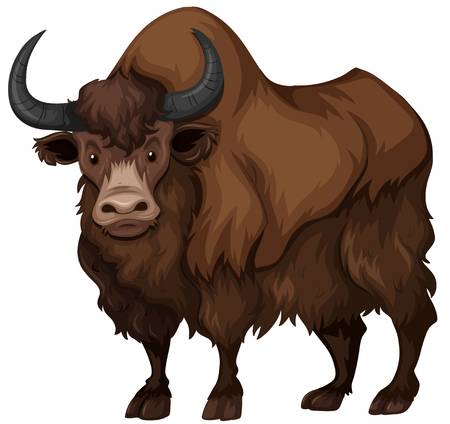
Over Thanksgiving, my daughter commented how she missed the Tibetan food she used to enjoy in Los Angeles. Not that Colorado doesn’t have Tibetan food (she relocated to Denver six months ago), but perhaps not as easy to find as in LA. The only thing I associate with Tibetan food is yak, which is more of an animal than a food in my book. But no doubt there’s also butter tea on that restaurant menu. Butter tea is made with yak butter. And if it’s anything like butter coffee, it’s better than it sounds.

Ever wonder at what point a fad becomes mainstream? That’s my musing with butter coffee today. I thought it was a come-and-go kick, until a recent Wall Street Journal (WSJ) article suggested it may be here to stay. Butter coffee is exactly as advertised: blended coffee with butter (and a little coconut oil); hold the cream and sugar. It sounds like a bizarre combination, but don’t judge until you try. Unless you prefer the sweet side of the Starbucks coffee menu, you’ll probably agree – butter coffee’s not that far removed from the taste of a standard latte.

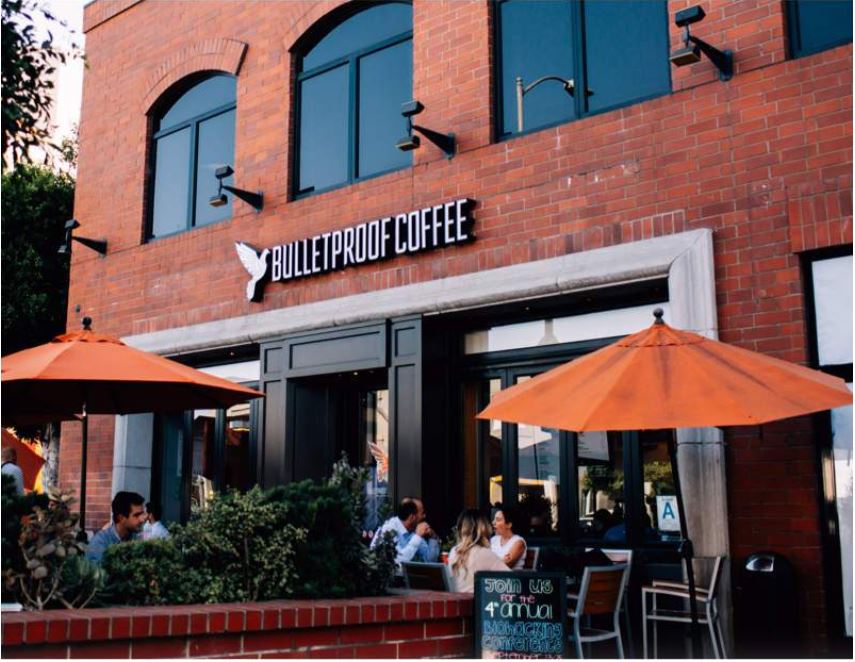
Without sounding like an advertisement, I have to give cred to Dave Asprey and the Bulletproof brand. Until somebody challenges his claim, Asprey is the standalone founder of the butter coffee trend. No surprise, his concoction is based on butter tea, which he first tasted not in a restaurant in LA, but on a mountainside in Tibet. Once Asprey formalized his invention into Bulletproof Coffee, he dropped his Silicon Valley ties and headed his career in a whole new direction.
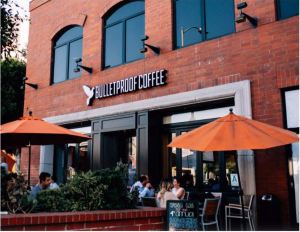
Though I ordain Asprey the butter coffee king, it’s been several years since I’ve actually read anything about the product. I was sure it was a here-today/gone-tomorrow health kick (if you’re a ketogenic diet fan, butter coffee’s for you). Then here comes the Wall Street Journal this week, touting “the latest coffee craze” and talking about enough recipes, products, and retail stores to make me think butter coffee is here to stay. I can even mail-order my butter coffee (at Picnik’s website). In the ultimate test of staying power, Starbucks may add butter coffee to its menu one of these days. If that happens, I’ll quit saying “fad” and promote the mixture to on-trend – which is how Google Maps already labels the Bulletproof Cafes you can visit in Seattle and Los Angeles.



Lest you think this post is a promotion for butter coffee, let me back up the barista a bit. Butter coffee purists (snobs?) assert the real deal can only be achieved with the highest-quality ingredients (“no crap, no yeast, no gluten”): certified-clean French-pressed coffee beans, medium-chain triglyceride oil (MCT), and grass-fed ghee (“non-dairy” butter). Who the heck has those items just sitting around their pantry? Furthermore, the ingredients need to be whipped up in a blender (oil and water – they don’t mix). That’s a lot of prep – and a few extra dishes in the sink – for a single cup of coffee.
Butter coffee’s fringe-benefits claim is “excessive productivity, limitless energy, and mental clarity” (with a large helping of fat). Maybe, but I’ll still take my no-brainer-mass-produced-K-cup coffee with a small pour of cream (instructions: press Start). That’s about all I can manage first thing in the morning anyway.
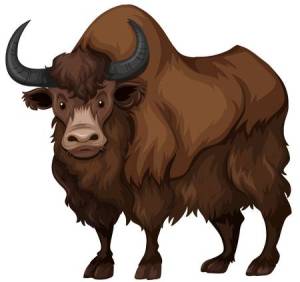
If you’re still curious about butter coffee, check out the entertaining BuzzFeed post: I Drank Butter Coffee For A Month And It Was More Magical Than I Expected. The authors gave it better chance than I did (even though they also retreated to standard coffee afterward). As for me, it’s K-cups over yaks every time.
-
A Distant Third (cont.)
Last Tuesday in cycle class, pedaling through the five-minute recovery after an hour of torture, our instructor asked if we’d like a Christmas carol or two from her playlist. The one rider with enough oxygen lashed out vehemently, “NO! It’s too early!” Well how about that; score a point for Thanksgiving. The sun set on Halloween two weeks ago and mighty Christmas is already trying to muscle its way to the forefront. But Thanksgiving has a thing or two to say first. If you please, keep the sugar plums out of my turkey and stuffing.
 In last week’s post, I compared popular aspects of Halloween, Thanksgiving, and Christmas (i.e. history, music, food). The final tally: Christmas the clear winner – no surprise – with Halloween solidly in second. But lest we relegate Thanksgiving to the bronze medal year after year, my blog-intent is to reinvigorate America’s late-November holiday, and remind readers why Turkey Day stands on its own merits.
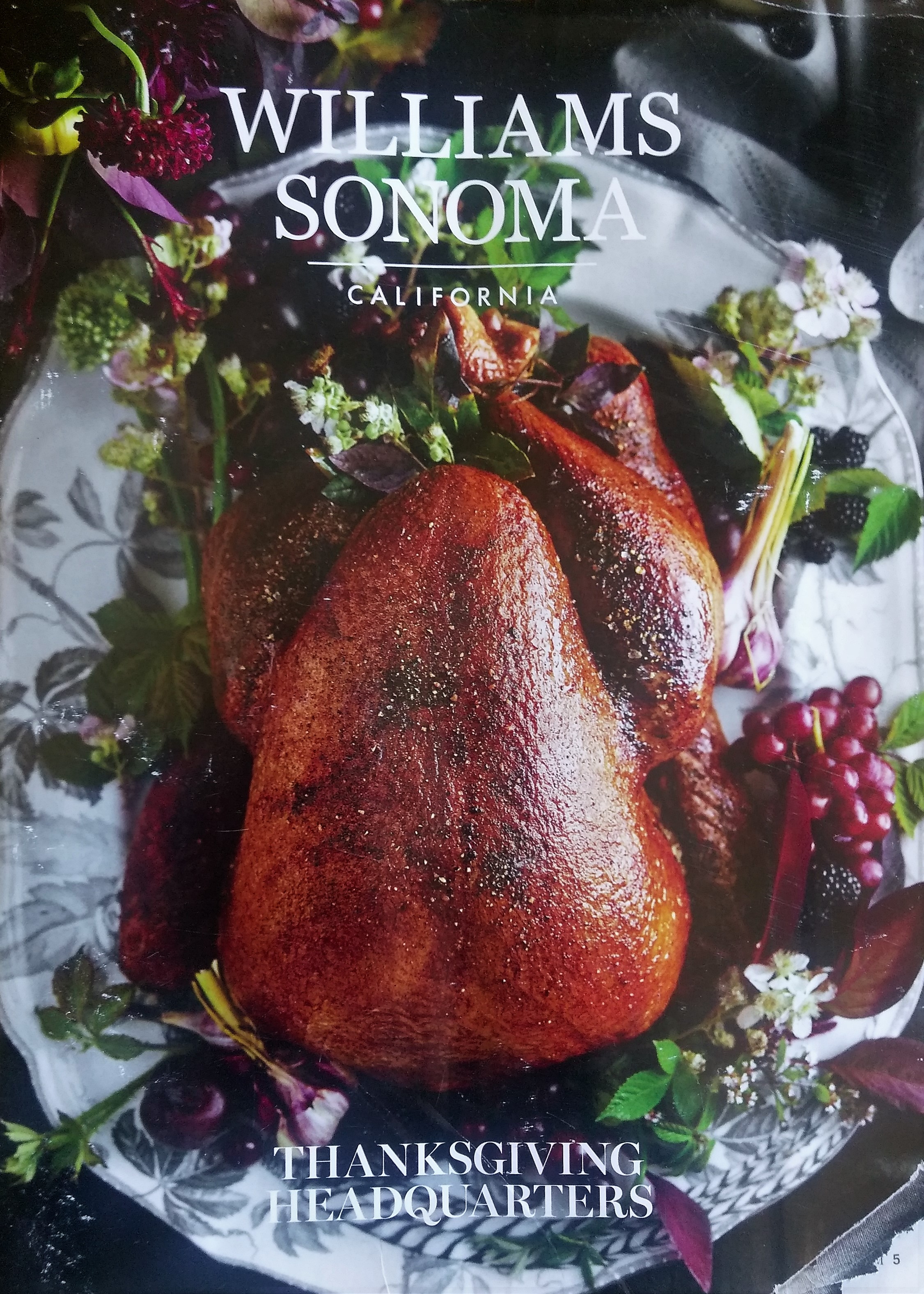
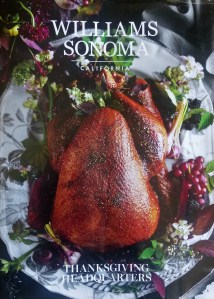 On that note, we’re starting November with promise. My wife is getting endless mailbox catalogs, and I was delighted to find Williams-Sonoma’s “Thanksgiving Headquarters” edition: 180 pages of food, linens, kitchenware, and decor specifically designed for the holidays. They even photo-profiled a barn-based “Friendsgiving” celebration in upstate New York. Granted, the Thanksgiving section of the catalog ended on p.67, meaning the remaining 100 pages were all about Christmas. No matter – 67 pages of Thanksgiving is impressive. Way to go, Williams-Sonoma.
 Starbucks also made a statement – albeit more feeble – putting their unique spin on Thanksgiving. Right now, you can drive-thru and order a Turkey & Stuffing Panini (with cranberries and gravy!), perfectly nicknamed “a handheld turkey dinner”. Then pair your panini with a Chestnut Praline Latte (“flavors of caramelized chestnuts and spices, topped with whipped cream and spiced praline crumbs”). That combo speaks more to November than December in my book. Not bad, Starbucks.
Retail aside, Thanksgiving plays out as more of an extended weekend than a single day. Consider the before/after events. Wednesday (“Thanksgiving Eve”) is routinely labeled “the single busiest travel day of the year”. Well guess what? It’s not. Thanksgiving Day is the busiest travel day of the year, considering 90% of us drive our cars to the family gathering that morning. Thanksgiving Wednesday (and Thanksgiving Sunday) only seem busiest because the chaos at the airports gets so much attention.
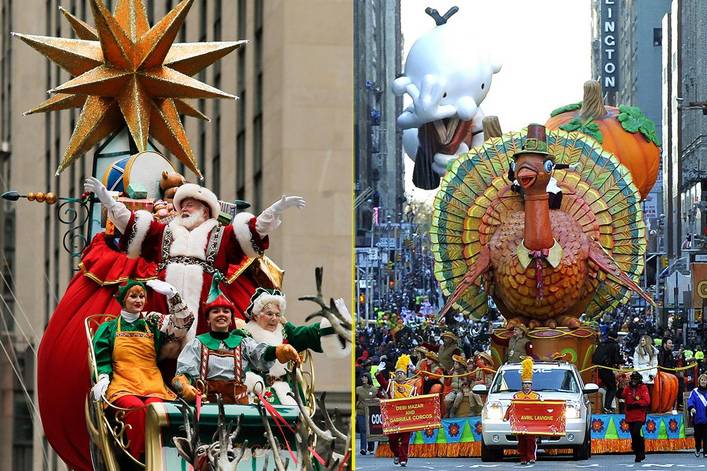
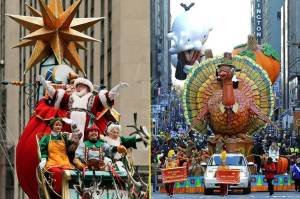 Now, on Turkey Day itself, besides the meal and the backyard football, we begin with the “Macy’s Thanksgiving Day Parade”. My family always seems to miss the broadcast because we’re so busy in the kitchen. Macy’s is three hours of marching bands, dancing Rockettes, Broadway singers, flying character balloons, and – as far as I can tell – one nod to Thanksgiving (the massive turkey in the photo above). But hang on ’til the very end of the broadcast, because… here comes Santa Claus, here comes Santa Claus, wrapping up the parade the same way he’s done every year since 1924. It’s like the Williams-Sonoma catalog – Thanksgiving on the outside but more “holiday season” in disguise.
Thanksgiving Friday is “Black”, of course – the so-called beginning of the Christmas shopping season. We Americans spend over $50 billion that day (putting retailers “back in the black” with profits – hence the name). It’s safe to say this bonanza of spending isn’t going away anytime soon. By its very nature, Black Friday extinguishes Thanksgiving – almost before the pumpkin pie is served. Black Friday sales begin as early as 5pm on Thursday evening (making the name obsolete, don’t you think?) And if Thanksgiving isn’t early enough for you, some stores begin sales a week before Black Friday, with the teaser, “avoid the chaos of Black Friday – shop now!” Uh, what’s the real meaning of Christmas again?
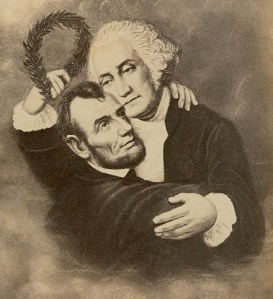
So there you have it – Christmas putting the squeeze on Thanksgiving like the Grinch on Whoville. Santa concludes the Macy’s parade at 12:00pm ET. Christmas shopping begins five hours later. In between, throw a meal on the table, mumble a blessing, and don’t forget to say thanks. If we’re not careful, Thanksgiving Day will be reduced to Thanksgiving Hour. It’s a phenomenon known as “holiday compression depression” (okay, I just made that up), but hey; it’s happened before. In 1971, George and Abe got their standalone birthday celebrations mashed into a single holiday. Even they feel Thanksgiving’s pain.











About Me
The sky is not completely dark at night. Were the sky absolutely dark, one would not be able to see the silhouette of an object against the sky.
Follow Me On
Subscribe To My Newsletter
Subscribe for new travel stories and exclusive content.
 Life In A Word