Hello, I’m Veronica
The sky is not completely dark at night. Were the sky absolutely dark, one would not be able to see the silhouette of an object against the sky.


-
Only In Iowa
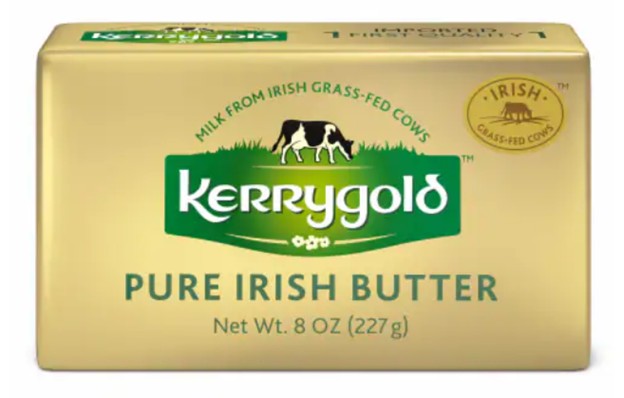
If you’ve ever made graham crackers from scratch (which are miles better than the store-bought ones), there’s a step in the recipe where you have to get your hands dirty. Take a stick of butter, cut it into very small pieces, dump the pieces into the mixture of dry ingredients, and dive on in with your fingers until the dough starts to clump together. It may be the only time butter and my hands ever come in contact with each other. Which is also to say, I won’t be sculpting a butter cow any time soon.

Sculptor, cow Creating art out of food seems like an inevitable destination. I mean, back in Michelangelo’s day everyone was taking a block of marble and seeing what they could do with it. Then all but one of them quickly realized there was only one Michelangelo. The others probably turned to an easier material to work with like wood or clay. 1,000 years on, we’re sculpting food. Chocolate is a popular medium. Cakes are shaped into just about everything imaginable. But a cow made out of butter – what’s that all about?

A more fitting Hawkeye State image We turn to Iowa to learn more about this oddity. Most people prefer to fly over Iowa but since you’re reading and not flying, let me enlighten you. On the list of 10 Things to Know About Iowa, there is no butter and there is no cow. There are a lot of pigs (the most of any state) and millions of acres of corn (also “the most”), and Iowa’s “Hawkeye” nickname is a reference to the birth of the red delicious apple (who knew?). But none of this gets us to butter and cows.
The “10 Things…” list does mention the Iowa State Fair, and it is here that we find real cows by the hundreds… and a life-sized one made out of butter. The Fair, whose 2025 edition wrapped up three weeks ago, has been making “buttered cows” since 1911, thanks to five Iowans who’ve passed the butter baton down over the years. The latest, Sarah Pratt, has been making the cows for the last nineteen years, and only after apprenticing with the last sculptor fifteen years before that. Some people blog; others make cows out of butter.

The 1911 original Like papier-mâché, a butter cow is created on top of a frame built from wood, wire, and/or metal. Then we heap on some fun statistics. 600 lbs. of “low moisture, pure cream, Iowa butter” is applied to create a cow that’s five-and-a-half feet tall and eight feet long. The sculptor’s “studio” is a walk-in cooler set to 40ºF. After the cow is displayed at the fair, all that butter is recycled for use on the next ten years of cows. Unless you’d rather use it for toast, which would butter 19,200 slices.
Michelangelo didn’t stop sculpting after his famous David, of course, and neither does Sarah Pratt with her butter cows. Also following tradition, she creates a “companion sculpture” to keep the cow company. Sometimes the companion is an homage to Iowa, such as a John Deere tractor. Most years the companion is a random anniversary, like the 40th anniversary of Neil Armstrong’s walk on the moon (totally random because Neil wasn’t born in Iowa). This year the sculpture featured the characters from “Toy Story”, denoting the movie’s 30th anniversary. You get the feeling Sarah enjoys sculpting butter so much that a life-sized cow just isn’t enough.

Woody, Buzz For all of my research, I can’t figure out why a cow made out of butter and Iowa belong in the same sentence. Nearby Wisconsin and Michigan are better known for dairy cows. California tops the list of the five states producing the most butter (and Iowa isn’t one of the other four). No matter, this tradition isn’t stopping anytime soon. The butter cow even has a place in the Smithsonian Institution (thankfully, as a replica that will never melt).
 I love butter, but more on top of baked goods and in graham cracker recipes than in the shape of a cow. I will admit to buying my butter by the brick instead of by the stick. But now that I know about Iowa’s annual creations, I’ll never look at my morning toast again without thinking, mooooooooo.
Some content sourced from the Iowa State Fair website, the U.S. News article, “10 Things to Know About Iowa”, and Wikipedia, “the free encyclopedia”.
-
Ten Days to “Ben-Yays”
I’ve never met a French baked good I didn’t want to devour at first sight. Macarons have called my name ever since my wife and I tried them in a little shop in Strasbourg. I’ve made a surprisingly good Croquet Madame (disguised as a three-cheese breakfast pizza) considering my limited skills in the kitchen. And croissants, well, croissants speak for themselves don’t they? So when a neighbor challenged my wife and I to make beignets ten days ago, I confidently replied, “oui!”

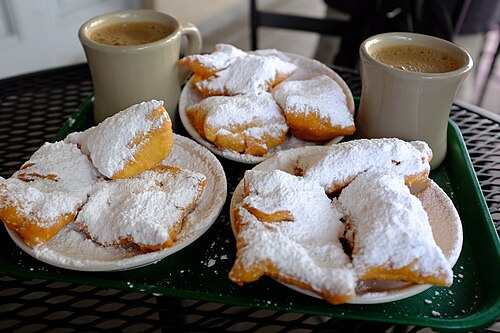
“ben-yays” Technically we’re not talking about a baked good today. Beignets are fried in oil, like doughnuts. In fact, they’re exactly like sugar doughnuts, just not as sweet. Think Krispy Kreme’s Original Glazed without the glaze. Small, chewy pillows of heaven.
So why would a neighbor request beignets? Because she invited us to a college football game watch (Clemson vs. Louisiana State) and she’s one of those who turns a basic entertainment into a full-on festivity. Louisiana State is in Baton Rouge so her menu was start-to-finish Cajun. Étouffée. Muffuletta. Red Beans and Rice. Chantilly Cake. I mean, if she’s going to make all of that how could I say non to beignets?

étoufée Thankfully, I found an “Easy Beignets Recipe” online (note: whenever a recipe starts with “easy”, it’s anything but). At least I already had the ingredients in my pantry. But beignets start out like a high school science experiment. Heat the water to exactly 105°. Add yeast and a little sugar, because yeast “feeds” on sugar. Then watch it all foam. If it doesn’t foam, you killed the yeast and you have to start over. (No pressure Dave, little lives are at stake here.)
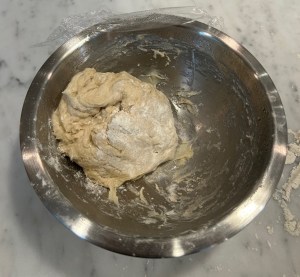
science experiment My yeast foamed (it lives!) so I was then allowed to proceed with the more traditional ingredients. Shortening, sugar, milk, and egg whites all mixed together, to which you add boiling water. When the temp is exactly 105°-110° (again with the science experiment) add the foamy yeast, flour and salt, and into the refrigerator it all goes, to rise for an hour or more.
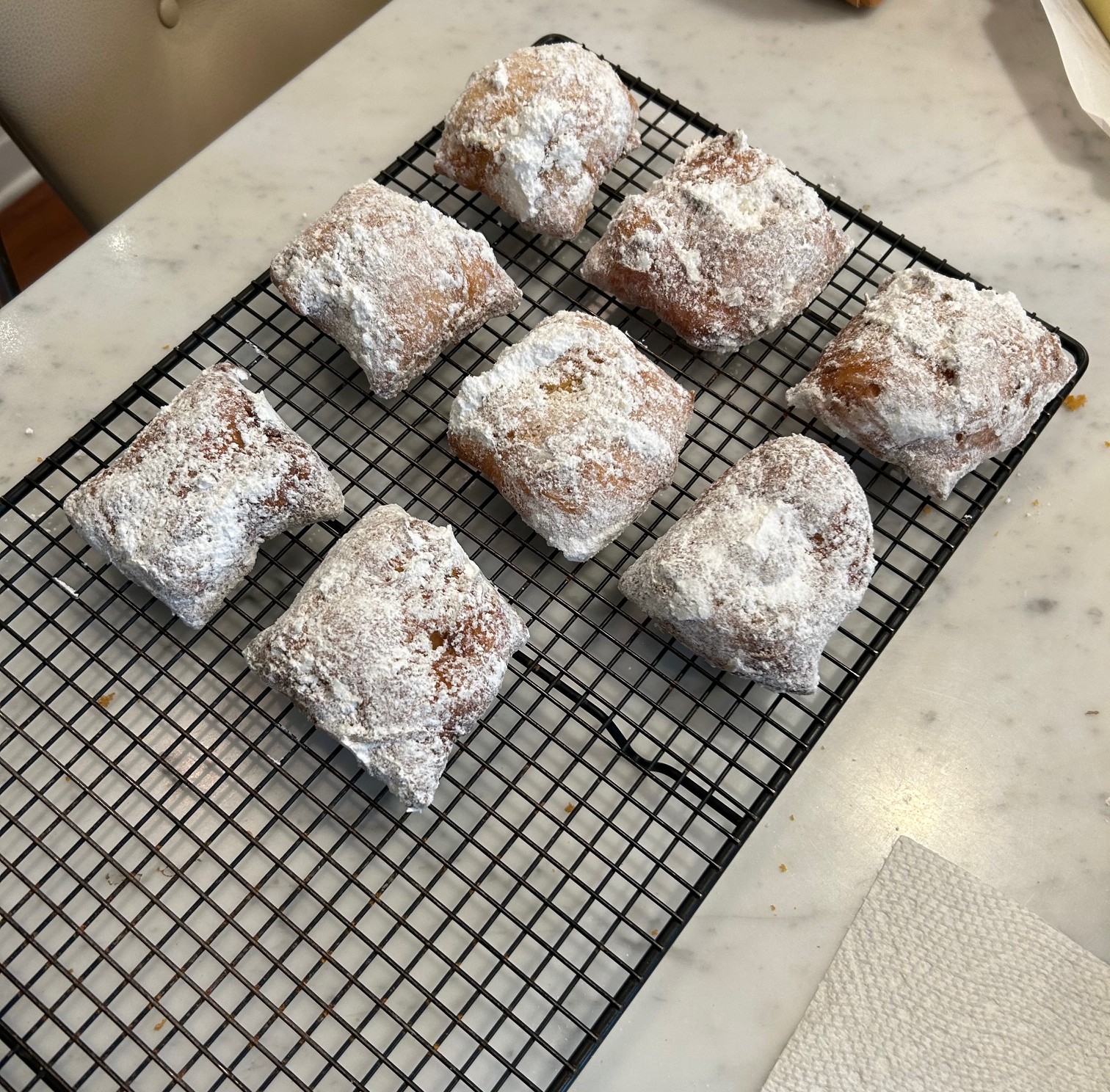
Did my foamy-yeast-shortening-and-other-stuff concoction really rise? I have no idea. It looked the same as it did an hour before. But I threw caution to the wind and proceeded. At this point my wife had to get involved, because (as the recipe warns in capital letters), THIS IS A TWO-PERSON JOB. Maybe a three-person. One of you slaves over a pot of boiling oil (my wife), another gently transfers the beignets to paper towels to “oil off” (me), and the third suffocates them in powdered sugar (me again).

Handle with care! That last sentence happens very quickly. You can’t get the timing wrong on any step or the beignets won’t taste right. They fry for a minute or so on each side, rest for a minute on the paper towel, and don their coat of powdered sugar with just enough oil remaining to serve as the glue.
When beignets are done correctly, they’re light and flaky. The shortening and yeast create an air pocket inside. But you’re not really sure if this science happens until you rescue them from the boiling oil. Remarkably, ours really did rise. Doused in powdered sugar they really were pretty good (then my wife mixed a little cinnamon and vanilla into the dough and they were even better).
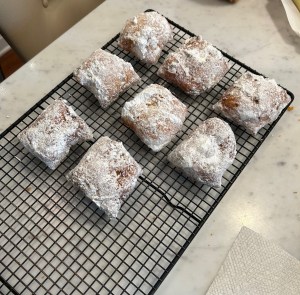
Magnifique! There’s a reason why beignets are so much better at the famous Cafe du Monde in New Orleans than in Dave’s kitchen. You need to eat them as soon as they’re powdered with sugar, and wash them down with a top-shelf cup of coffee. You see, beignets, sadly, have the shortest life of any baked good I know. If you don’t eat them warm, minutes after they’re fried, they’ll shed their light and airy consistency. An hour later they’re as cold and chewy as day-old doughnuts at 7-Eleven. And God forbid you leave them overnight on the counter. The next morning you’ll have nothing but rocks.
 So, you ask, were our beignets a hit at our neighbor’s game watch? Well, let’s just say the other guests were being polite by declaring, “very good!”, especially when they ate more of our frosted sugar cookies instead (our backup dessert). Hey, our kitchen is no Cafe du Monde. I never said it was. It’s the reason I’m never making étoufée. At least I have a neighbor who will be happy to do it for me.
Some content sourced from Wikipedia, “the free encyclopedia”.
-
Where The Buffalo Roam
In southwestern Alberta, Canada, there’s a historical landmark curiously named “Head-Smashed-In Buffalo Jump”. It’s the former location of a vast communal bison trap. Thousands of years ago native hunters would drive herds of the roaming animals over the plains and then right over the adjacent cliffs, in what is described as “the single greatest food-gathering method ever developed in human history.” The buffalo aren’t running in this part of Canada anymore. They’re no longer running in Boulder, Colorado either.
 In case you missed it, the American college football season kicked off last Saturday… in Dublin, Ireland. Kansas State played Iowa State in a converted rugby stadium in front of a sell-out Guinness-filled crowd. A roving reporter took to the streets to ask locals what they knew about the American game and the answers were wonderfully ignorant. How many points is a touchdown? (“4?”) Name any American college football team (“Yankees?” “Dodgers?”) And then my favorite: What is Kansas State’s mascot? (“A tractor?”) Not a bad answer if you ask me. I’d guess there are more tractors than wildcats in Kansas.
Ralphie’s run Speaking of wild things, let’s get back to Boulder. The University of Colorado (CU) boasts one of the few live animal mascots in college football: a full-grown snortin’ stompin’ buffalo named Ralphie. Before each half of the home games Ralphie is released from her trailer on the sidelines (yes, Ralphie is a “her”) to run a horseshoe lap around the field at full speed, before her five handlers corral her back into the trailer. It’s the stuff of rodeos, and more than a few handlers have eaten dirt in the process (but at least they earn a varsity letter for their efforts).
 Ralphie is actually the sixth live buffalo to represent CU since the mascot was selected in 1934. But Ralphie VI – aka “Ember” – has a singular distinction. She’s just not into the run. Whereas her five predecessors ran for at least ten seasons each, Ember decided to call it quits after just three. The University officially called it “indifference to running” and cut Ember from the team so she could spend the rest of her days roaming in pastures. Maybe Ember’s thinking she’s going to go over a cliff every time she runs. Can you blame her for hanging it up? No word on whether Ralphie VII is up for the task.
At least CU has a ferocious mascot, one a fan would associate with the Colorado surrounds. Like Texas’s Longhorn or Florida’s ‘Gator, you want a mascot that speaks to your particular locale and does so with a confident puff of the chest. But instead, a lot of America’s college football mascots have you thinking either lightweight or what the heck is THAT?

Don’t mess with Texas! Cases in point. If I pull up this year’s top college football teams, I guarantee I’ll find several to underscore my point. And I am right. Ohio State’s mascot is a buckeye (which is a tree, and not a very ferocious one at that). Georgia’s is a bulldog, described as “loyal, gentle, and affectionate”. Oregon’s is a duck (A duck!) Alabama is known as “the Crimson Tide”, which was a reporter’s colorful spin on a long-ago game played in the mud (and not a mascot at all). Finally, Arizona State’s is a Sun Devil, which better belongs on Saturday morning cartoons than Saturday afternoon football fields.
On the other hand, you have the Penn State Nittany (Mountain) Lions, the Michigan Wolverines (don’t mess with wolverines), the South Carolina Gamecocks (don’t mess with those either), and the Miami Hurricanes (not an animal, but points for ferociousness and local flavor). Any one of those deserves to stand side-by-side with a live buffalo.

Notre Dame’s leprechaun As much as I’d like leave this topic with Ember the Buffalo and her chest-thumping buddies, I sheepishly include one more: my beloved alma mater Notre Dame. We at Notre Dame are the Fightin’ Irish, because our football teams (at least those from the early 1900s) showed “the grit, determination, and tenacity characteristic of Irish immigrants”) That all sounds great until you see our mascot: a leprechaun who looks like he’s taking a break from the Lucky Charms cereal box. Is there anything less ferocious and less “state of Indiana” than that?

NOW we’re talking! If it were up to me, Notre Dame’s mascot would be an open-wheeled, open-cockpit IndyCar (VROOM! VROOM!), the kind they race every year at the Indianapolis 500 just four hours south of campus. An IndyCar toughs out a jigging leprechaun by a mile, not to mention an indifferent buffalo who’d rather roam than run. I still say, good on you for choosing to head out to pasture, Ember. I wish the Notre Dame leprechaun would tag along.
Some content sourced from the Athabasca University Press article, “Imagining Head-Smashed-In”, the CUBuffs.com article, “Ralphie VI retires”, and Wikipedia, “the free encyclopedia”.
-
Shark Attack!
Our annual summer vacations in San Diego have become a little more adventurous because of an increase in shark activity off the coast of California. I enjoy body surfing, but the thought of a pair of big, hungry jaws beneath the water’s surface gets my heart a-pounding. So imagine my shock when I really did have an encounter with a baby shark. Er, make those letters capitals. I meant to say “Baby Shark”.
 My adorable two-year old granddaughter is just beginning to take off with her vocabulary. She can say “Mama”, “Dada”, and even “Chop! Chop!” when she wants us to hurry up. She also says “Bayba Shawk”… constantly, because she wants an adult to play the song for the forty-thousandth time. After three weeks on repeat I can’t get the darned thing out of my head. I need brain surgery.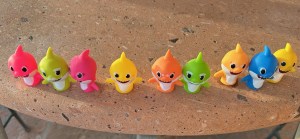
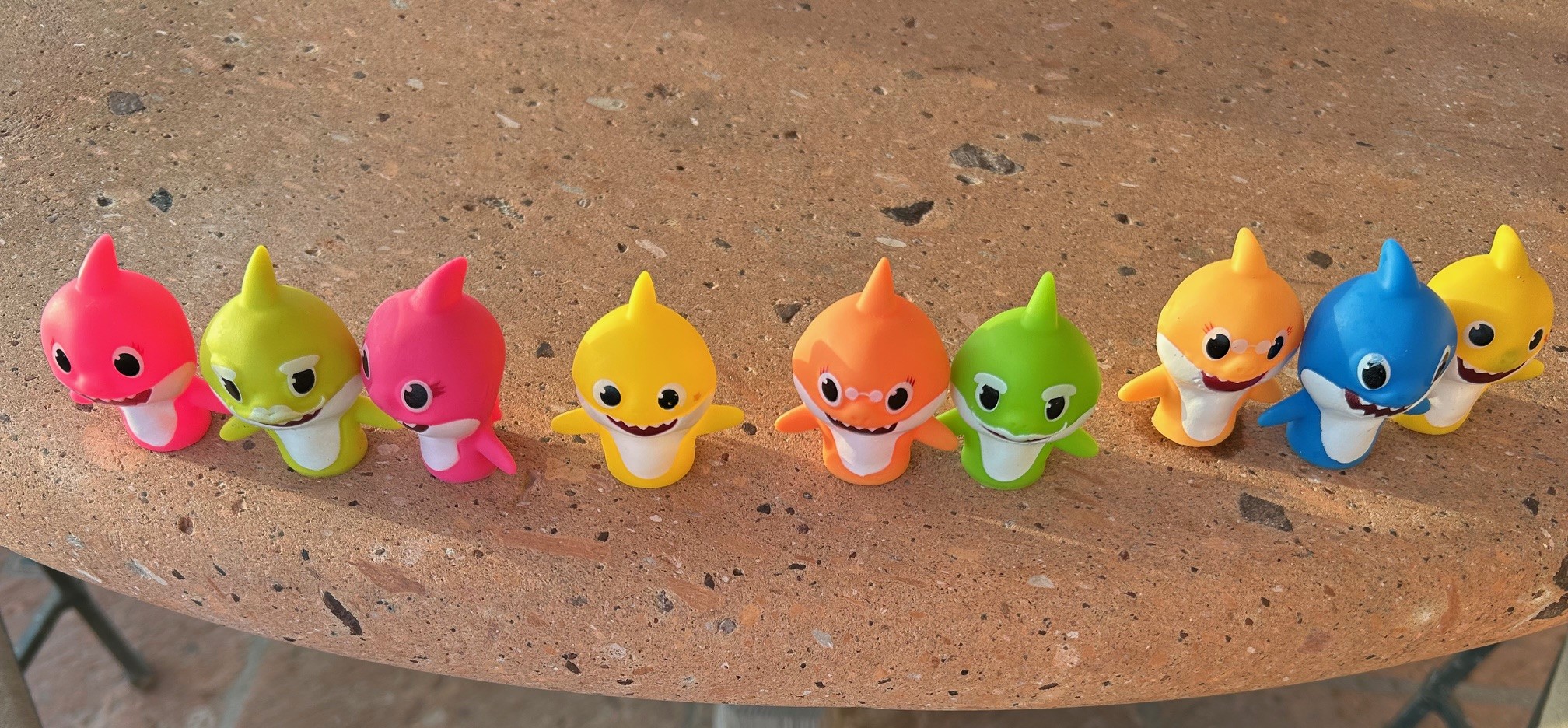
My granddaughter’s finger puppets “Baby Shark” is the story of a little family of sharks hunting for fish. The fish get away and… that’s it. It’s not so much a story as an excuse to sing a verse about each family member: Baby, Mommy, Daddy, Grandma, and Grandpa. The first time I heard it (forty thousand time ago) I wondered, Why doesn’t Baby Shark have siblings? Where are his (her?) other grandparents? Aunts? Uncles?
Of course, it’s not really Baby Shark’s family that make the tune so addicting. It’s the “doo’s”… as in doo doo doo-doo doo-doo. You sing those six “doo’s” in every verse and that’s the part that gets into your head. Add in the accompanying up-and-down arm dance (imitating the jaws of a shark) and you somehow have a hit. More like a worldwide phenomenon.
If a children’s sing-song doesn’t get your attention, consider this. “Baby Shark” is the most-watched YouTube video of all time. I said of all time. If your guess would’ve been something by Ed Sheeran or Katy Perry or Maroon 5 you would’ve also landed in the Top Thirty, but nowhere near the top of the list. “Baby Shark” has been viewed over 16 billion times, more than twice the number as the runner-up. And that’s only for the version from South Korea’s Pingfong. The one by Cocomelon (a children’s YouTube channel) lands in twenty-third place with another four billion views.
The “Baby Shark Dance” “Baby Shark” has been around longer than you might think. It showed up somewhere in the late 1990’s in the public domain. Then Pinkfong got ahold of it, created the 2016 video with cute little Korean kids, and the rest continues to be history. Coincidentally, a lawsuit was settled just this month where an American songwriter claimed rights to “Baby Shark”. He lost, but only because the song was still in the public domain when he created his version. You can’t blame him for trying; “Baby Shark” has generated over $150M in revenue in the last ten years.
Of course, all that revenue comes from more than just a YouTube video (hence the “worldwide phenomenon”). “Baby Shark” is showing up in places and with people that seem downright ridiculous. There’s a children’s book and a television series. There’s a video game. It’s part of a tourism promotion for Singapore. It’s used by certain professional baseball players as they walk up to the plate. Or certain politicians as they walk up to the podium. Finally, it’s the subject of a Kellogg’s breakfast cereal, a berry version of Fruit Loops with little marshmallows posing as sharks. “Yum?”
 My favorite use of “Baby Shark” comes out of West Palm Beach, FL. Local authorities were desperate to clear a lakeside pavilion of homeless people, so they played the song over and over on loudspeakers until everyone left (running and screaming for the hills, no doubt). If I’m inclined to run and scream myself, I can drive a couple hours north of here to see a production of Baby Shark Live, a 75-minute stage musical. I’m not inclined.
The whole time I’ve been typing this post I’ve had doo doo doo-doo doo-doo on loop in my head. If my hands and arms weren’t busy on the keyboard they’d be doing the Baby Shark Dance instead. It’s maddening, and makes me want to body surf again with hopes I’ll be eaten by a real shark. Instead, I’ll just hope I find another blog topic next week that consumes me more than “Baby Shark”. I leave you with the video. Guard your sanity.
Some content sourced from Wikipedia, “the free encyclopedia”.
-
Golden Recall
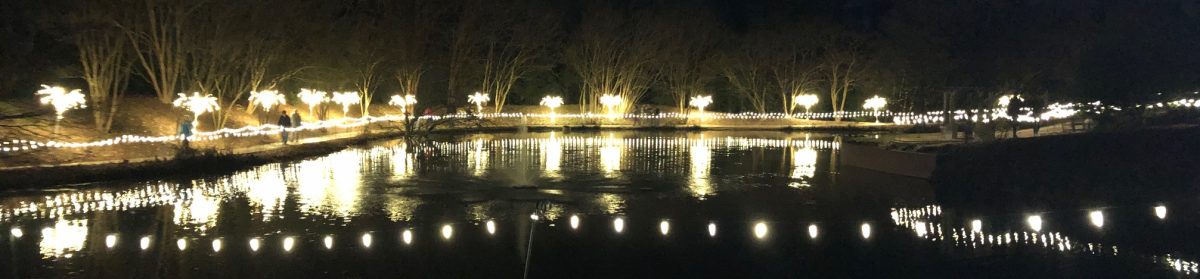
My wife and I go for massages once a month, which has turned out to be a solid therapeutic routine. As is the case with any spa, the air is diffused with pleasant scents as well as soothing instrumental music. They also overlay a soundtrack of birds, as if to place you in the out of doors. The sensations are designed to relax and they do their job; so well in fact I’d swear I was transported to the shores of a pond. More on that in a minute.
 Candidly, it’s not often I notice the background music in a spa. I focus on breathing deep and keeping my eyes closed instead. But I couldn’t ignore the music when “Bring Him Home” from Les Miserables started playing. Whatever playlist the spa chose included a simple rendition of that song; just piano and violin. It was beautiful, and suddenly I was back in the Broadway theater where we saw the show years ago. I would’ve put “Bring Him Home” on “repeat” if I could have.
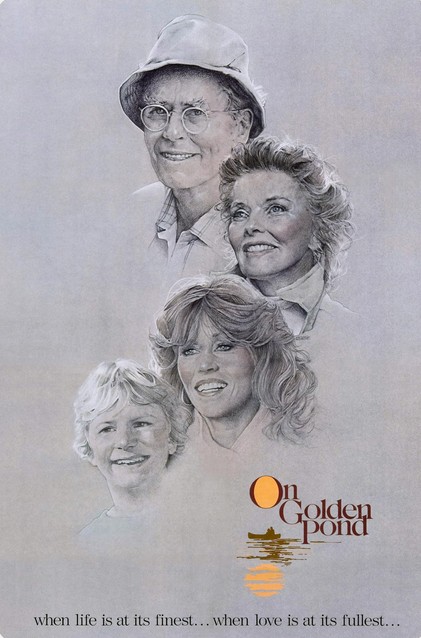
But we’re not talking about Les Miserables today. We’re talking about a pond. “Bring Him Home” was followed by a nameless instrumental piano piece, and again my mind began to drift. Then I heard the birds. Piano keys. Birds. And there I went… back to “On Golden Pond”.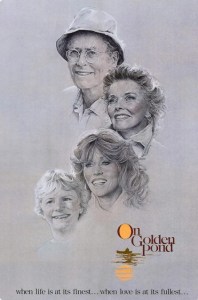 Several instrumental movie soundtracks will reside in my brain forever. Whenever their signature melodies play I’m immediately returned to the film itself. I’m not talking about the bold, orchestral works of John Williams (think Star Wars or Jurassic Park) but rather the simpler repetitive tunes that still somehow define the story on the screen. Chariots of Fire is a good example. Cast Away is another. Leap Year was a so-so movie but the soundtrack is wonderfully catchy. And the music of A Little Romance – Diane Lane’s debut film – was so well done it won 1979’s Oscar for Best Original Score.
 So you see, this is how a massage becomes a trip back to On Golden Pond, a movie from almost fifty years ago. The piano plays. The birds sing (even if they aren’t loons). And there it is, that simple poignant story playing out in front of my closed eyes as if I’d just seen the film last week.
Was I ever a fan of Jane Fonda? Not really. I remember her more for her workout videos than her movies. But On Golden Pond was the exception because she’s on screen with Henry Fonda, her father in real life and her father in the movie. The movie is about the struggles of their father-daughter relationship, which surely echoed real life. Add in Katherine Hepburn as the mother character and the bar is raised well beyond the movie itself. The story is good enough, but who from my generation wouldn’t watch Henry Fonda and Katherine Hepburn in anything together? Henry Fonda died less than a year after the filming of On Golden Pond. Katherine Hepburn made a few more movies but this was pretty much the conclusion of her career as well. So On Golden Pond is something of a swan song for both. If you have any recollection of the film, try this: Ask Alexa for instrumental piano music. Ask Siri for a soundtrack of birds at the same time. Then close your eyes and relax. You may be transported back to a golden pond. It’s pretty cool.
Some content sourced from IMDB, the “Internet Movie Database, and Wikipedia, “the free encyclopedia”.











About Me
The sky is not completely dark at night. Were the sky absolutely dark, one would not be able to see the silhouette of an object against the sky.
Follow Me On
Subscribe To My Newsletter
Subscribe for new travel stories and exclusive content.
 Life In A Word tv