
She’s only fourteen months and our granddaughter has already developed a keen interest and affection for our horses. As soon as she gets to the house she hightails it to the living room windows to see if our big boys are grazing in the nearby pasture. She calls them “Neigh-Neighs”; just about the cutest couplet of words you’ll ever hear from the lips of a small child. Makes me think she’d be utterly over the moon if she ever caught a glimpse of the Neigh-Neighs… er, horses at the Spanish Riding School in Vienna.
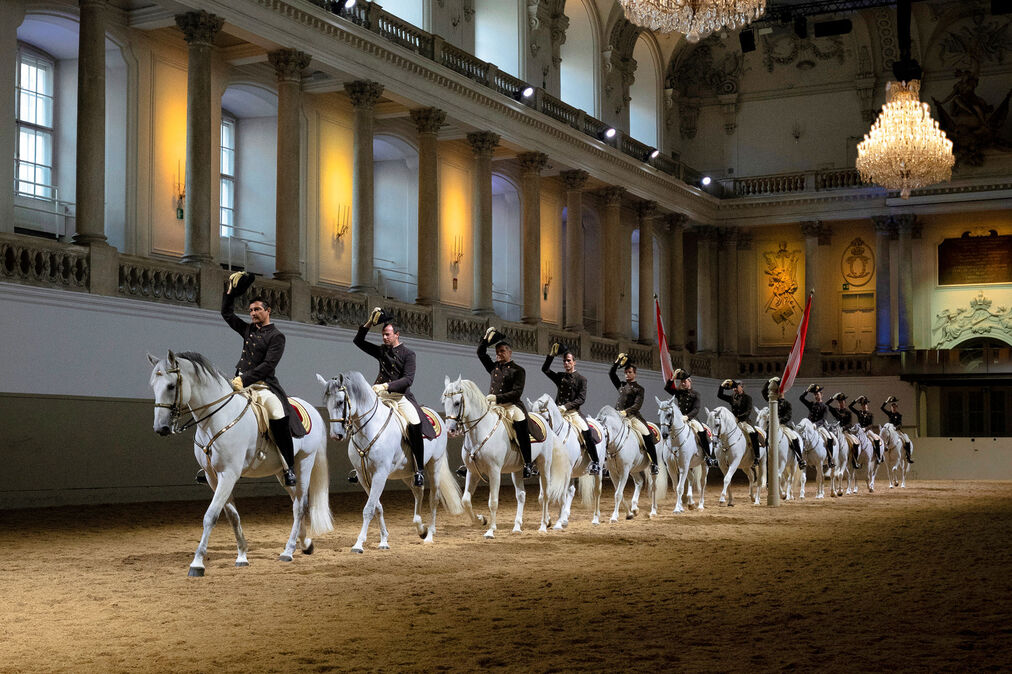 If you asked me to describe the nerve-wackiest moment of our Viking River Cruise last month, it would’ve been nine months beforehand when I went online to book the sightseeing excursions. One of those tours – “Behind the Scenes at the Lipizzaner Stallions” – was, at least for us, the excursion of the entire trip. If the Lipizzaners were sold out, well, there’s a good chance we would’ve a) cancelled the whole cruise, or b) emptied a nearby ATM of Euros, in hopes a couple of our fellow travelers would give up their reserved seats. Lucky for us we didn’t have to do either.
 Maybe you’ve heard of them before. The Lipizanners are a renowned breed of riding horse developed in sixteenth-century Austria. All these years later they’re among the world’s most famous animals, both for their uniform look and unparalleled skill in the movements of classical dressage. Five of these movements – known as “airs above the ground” – require horse and rider (sans stirrups) to completely leave the ground. It’s a performance you’ll only see at prestigious academies like Vienna’s Spanish Riding School, and not in, say, the Olympic dressage competition later this month in Paris.

So how was this remarkable performance? I wish I could tell you. We were in Vienna on a Tuesday and the Lipizzaners only show on Saturdays and Sundays. But we knew this was the case heading into our trip. The draw of the excursion was more about a behind-the-scenes look at the riding school facility, learning about the care and training, and of course, a peek at the horses themselves. The Spanish Riding School is located in the former Imperial Palace of the Habsburg Monarchy, smack-dab in the middle of downtown Vienna. Were it not for the smell of hay and manure you wouldn’t even know the stable was right through the stone walls adjacent to the sidewalk.

But oh my, what a stable! Each of the 68 resident stallions enjoys a roomy private stall (with a fancy nameplate), as well as outdoor courtyards for fresh air and exercise. Those weekend performances take place in the spectacular sky-lit central hall, which still contains the royal box from the Habsburg era. The tack room contains custom-made saddles, bridles, and reins representing a small fortune in leather craftsmanship. And hay storage, manure removal, and other supporting aspects are somehow completely out of sight. The Lipizzaners have it as good as we’ve ever seen for horses, at least in an urban setting.

Speaking of the Lipizzaners, the Spanish Riding School is just a part-time residence. They spend a good portion of the year in nearby Heldenberg, enjoying the peace and quiet of the countryside instead of the hustle and bustle of the city. Their breeding farm in Piber – even further removed from Vienna – is nicknamed “The Cradle of the Famous White Horses”. And as you might expect, most of the young Lipizzaners go straight from Piber to the easy life in Heldenberg, without so much as a glance at the Spanish Riding School. Only a select few achieve the look and confirmation worthy of this elite level of training and performance.
A couple weeks ago I described the Viennese Coffee House experience as an Element of Intangible Cultural Heritage. So it is with the Spanish Riding School. UNESCO has deemed the Vienna facility, the Lipizzaners, and their horse/rider performances as “an essential component… of [Austrian] cultural diversity and creative expression”.
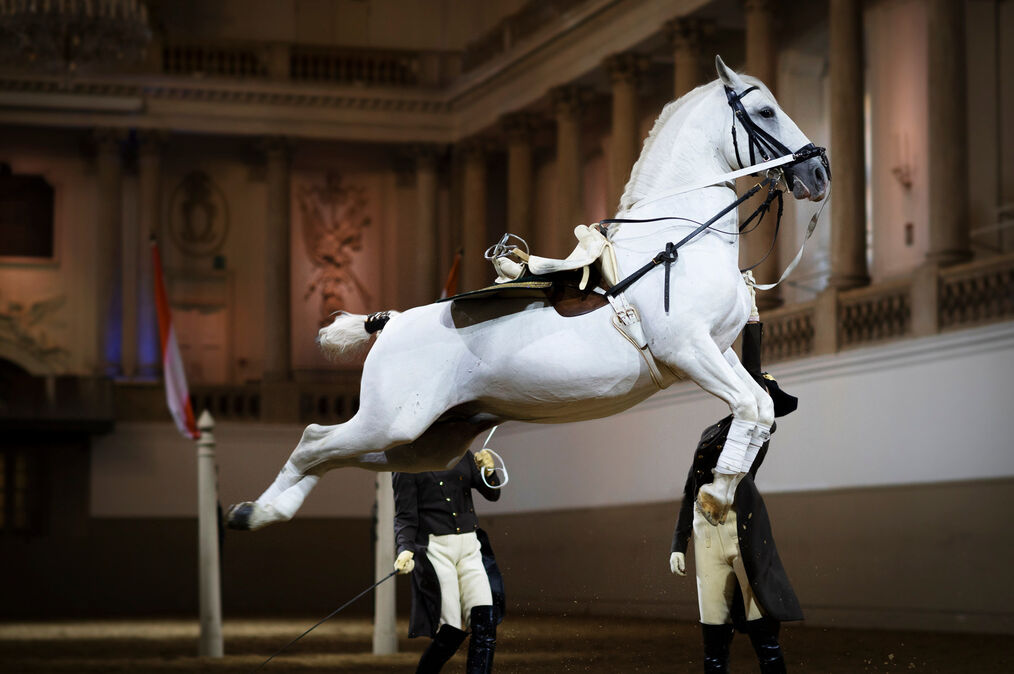
I can understand why most visitors to Vienna would choose to see the Lipizzaners in their “Sunday best” instead of lounging in their stalls. But I encourage you to see both. A visit with these beautiful animals up close and personal is a unique experience (even if most tourists don’t seem to know how to behave around horses). You’ll learn why the Spanish Riding School hosts one black stallion among the dozens of whites. You’ll learn the historical significance of the trained movements of the Lipizzaners, as well as how to identify a rider’s ranking based on his uniform and equipment. My granddaughter would have plenty of reasons to give this tour a “neigh-neigh”, but your own response is more likely to be “yay-yay!”
Some content sourced from the website of the Spanish Riding School, and Wikipedia, “the free encyclopedia”.

 Life In A Word
Great post. While I have not seen them, I did see a show about them years ago and was amazed at their beauty. Glad you were able to see behind the scenes look. Next time the actual show.
LikeLiked by 1 person
As if we need a good reason to go back to Vienna, right?
LikeLiked by 1 person
You are right!!
LikeLike
We too that tour too. Right after had coffee at a coffee house. We loved our trip there.
LikeLiked by 1 person
I think a trip back to Vienna is in order! Those horses sure look beautiful.
LikeLiked by 1 person
For these and so many other reasons! Munich too.
LikeLike
Vienna is sounding interesting. I’ve heard of these horses, they look beautiful and talented, but the only special horses we get around here are the Budweiser Clydesdales.
LikeLike
I like that thought, Ally. The Clydesdales don’t seem to be regulars in Super Bowl commercials anymore so maybe a trip to St. Louis is in order to see them in person.
LikeLiked by 1 person
Very clever title Dave … your granddaughter’s name for the horses is also clever and cute. I would enjoy seeing this behind-the-scenes look at the Lipizzaner stallions. When I was a kid, I can remember seeing the Lipizzaner stallions on a Disney show … perhaps a movie or documentary about them. The equestrian version of The Rockettes as they pranced about. I visited the Royal Winter Fair in Toronto once and enjoyed seeing a show of all the Clydesdale draft horses, their harnesses and hardware jingle-jangling as they proudly pulled the big wagons around the arena. It was a sight to behold.
LikeLiked by 1 person
The Disney movie was called “The Miracle of the White Stallions”, and our guide cautioned us about watching it since Disney took liberties with the story. Basically, Hitler took the horses to Germany during WWII; Patton helped to rescue them back to Austria later on. The better account is in a book called “The Perfect Horse”.
LikeLiked by 1 person
That’s interesting Dave. I was pretty sure I remembered the program as a Disney movie. I guess to make the Disney program suitable for children, they took liberties, softening the edges a bit.
LikeLike
I applaud your granddaughter for her contribution to your story. We saw the Lipizzaners in their luxurious stables, but unfortunately did not see them perform. A good reason to go back to Vienna!
LikeLiked by 1 person
Now I understand about your horse ranch in Colorado. What a delight to get to see the Lipizzaners!
LikeLiked by 1 person