
Hello, I’m Veronica
The sky is not completely dark at night. Were the sky absolutely dark, one would not be able to see the silhouette of an object against the sky.


-
Child’s Play
When I dove into piano lessons at the tender age of six, I learned the piano is “foundational”; a good place to start if your future destination is another musical instrument. The piano teaches concepts like keys, chords, and “Do Re Mi” in a straightforward way. My son learned about foundational instruments when he started the sax – it’s best to spend time on the clarinet first (the fingering is easier). But today I want to talk about real foundational instruments; the ones I dabbled in even before the piano. I can think of at least six (and one honorable mention).
 My granddaughters – ages 2 and 4 – already attend weekly music classes (which brings me no small amount of joy). They’re learning to sing and play simple rhythm instruments like drums and tambourines. So I shouldn’t have been surprised this past weekend when the older one pulled out a kazoo and began “playing” for me. Not a formal song or even a melody; just a handful of notes from what is technically a wind instrument.
Let’s call the kazoo Child’s Play (CP) #1. The kazoo starts my list of six because it’s undoubtedly the easiest to play. You simply hum into the mouthpiece and the kazoo takes care of the rest. The kazoo’s buzzing sound is utterly annoying and after a few seconds you wish it would just stop (unless your granddaughter’s playing, of course). The kazoo rides a fine line of the definition of a musical instrument. To be honest, I’d rather just hear a person hum.
 CP #2 – Triangle. The triangle has often been described as “having no musical function and requiring no skill to play”. A brutal (and fair) description to be sure, but consider this: the triangle is the only instrument on this list to earn a spot in a formal orchestra. You’ll find the little guy in the orchestra’s percussion section (alongside the drums and other rhythm instruments). The triangle also outclasses the kazoo since it’s cast from fancy metals (ex. beryllium copper, brass, bronze).
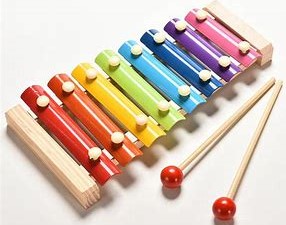 CP #3 – Xylophone. The xylophone tops the triangle because it’s a percussion instrument that can also carry a tune. There’s nothing more inviting to a small child than a set of colorful bars you can whack with mallets, and they make music! Sure, you can hum “Twinkle Twinkle, Little Star” on the kazoo but it’s much more fun banging it out on the xylophone. The xylophone gave birth to the vibraphone (an electronic version) and the marimba (a wooden version), both of which generate rich, warm, beautiful-sounding notes.
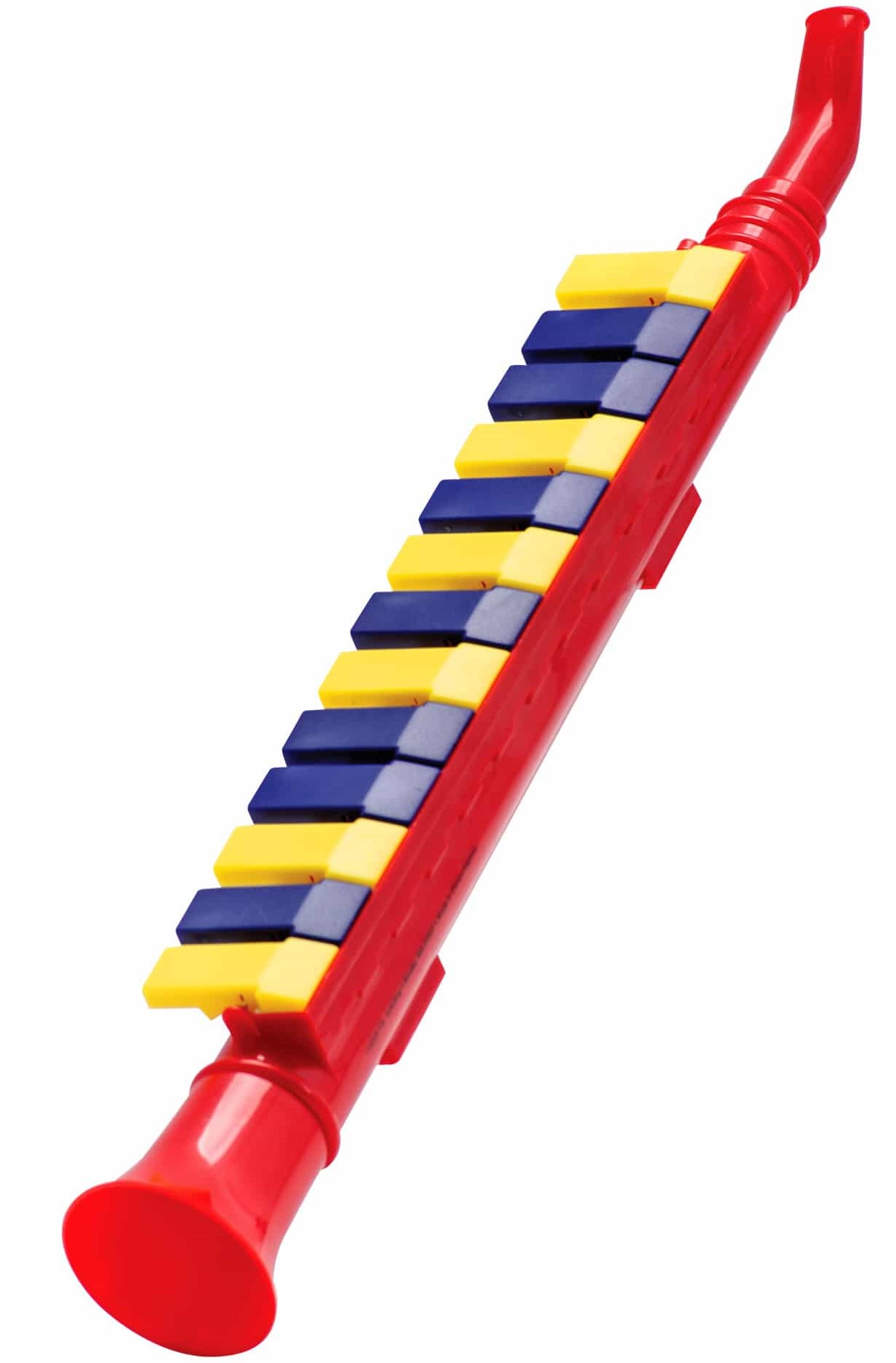
CP #4 – Recorder. The recorder ranks a close second to the kazoo on the annoyance meter. A child can pick up this woodwind instrument (the cheap plastic kind, not the fancy wooden one), blow into it, and instantly produce a note. The same child then realizes he can change the note by covering/uncovering the recorder’s holes. Now he can produce many notes. And what’s wrong with many notes? It just sounds like so much wailing. Watch the video (if you can stand it) and tell me if you don’t agree.
 CP #5 – Harmonica. The harmonica, another wind instrument, is also known as the “French Harp” or “mouth organ” (I prefer the former) and it comes in all shapes and sizes. A child will find his first harmonica in the same section of the toy store as the kazoos and recorders – where you find anything made of cheap, colored plastic for less than a dollar. Here’s what a child learns about the harmonica very quickly: he can fake it. If you hum into the harmonica instead of just blowing, you’ll create a pretty good imitation of what it’s supposed to sound like. You won’t fool anyone who really knows the harmonica but as a kid (that would be me), you thought it was pretty cool to whip out your harmonica and pretend you could play it.
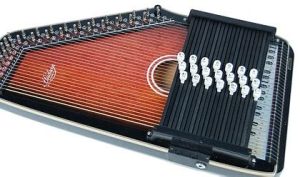 CP #6 – Autoharp. The autoharp made its first appearance at my elementary school choir classes. It was the coolest instrument I’d ever seen. It’s like playing the guitar (pick and all), only you press down bars to create the chords instead of using your fingers. One kid would be chosen from the choir to strum the autoharp while the rest sang. Playing the autoharp wasn’t cool, but being chosen to play it? That was pretty special.
 CP Honorable Mention – Hand Flute. The hand flute is a fancy name for whistling through two fingers or through the hands. I can’t remember when I learned to whistle (with just the lips) but I was certainly inspired by my dad, who gave the family a distinctive two-note greeting every time he walked through the door after work. But I never learned to whistle through my hands. The hand flute not only sounds cool (a lower note than a mouth whistle, like the cry of a nightingale) but it looks like you have a built-in musical instrument when you “play”.
 Wrapping up this topic suggests I pick a favorite instrument from the list above, but the choice is impossible. Each one is bonded to special memories from a long time ago. If I had more space here I’d add others to the list (like the tricky piano horn). Instead, let’s just agree the foundation of my piano play is a team of smaller, less-appreciated musical instruments. Child’s play? Hardly.
Some content sourced from Wikipedia, “the free encyclopedia”.
-
Too Much on My Plate
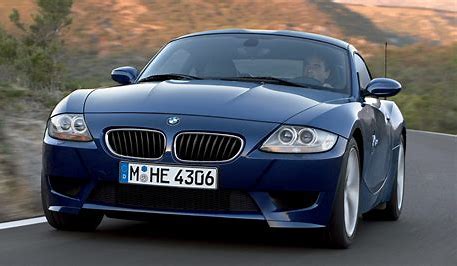
In the latest spin on subscription services, BMW will – for a small fee – heat the seats in your car. Maybe you saw this headline already and thought, “Fake News”. Afraid not. Rather than simply pushing the heat-the-seat button on your 3 Series sedan you must contact BMW first, who will remotely unlock the feature and charge you by the month. A separate soon-to-be-offered subscription gets you a heated steering wheel. I shouldn’t be surprised by this latest cash grab at the expense of driving comfort. After all, we’re also about to enter the era of electronic license plates.
 I find U.S. license plates to be mini-artworks, don’t you? They’re colorful, often including an image or slogan to proudly advertise the state itself. The letters and numbers raise from the rest of the aluminum rectangle, giving the fingers a pleasing sensation when you brush over them. Drivers who choose “vanity plates” offer the rest of us on the road a puzzle, to figure out what phrase the chosen letters/numbers represent (and never getting the chance to ask). The U.S. Mint should take a cue from colorful license plates and print American dollars with the same pizzazz. After all, “greenbacks” are anything but mini-artworks.
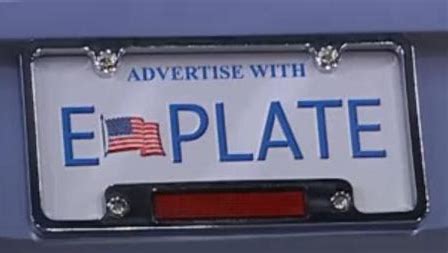
 But I digress. Today we’re talking about license plates, displaying numbers and letters in pixels instead of raised metal. My first thought when I read about electronic license plates? Fraud. I mean, seriously, how easy will it be to hack into the software and alter the numbers and letters, effectively rendering the vehicle impossible to track? Or worse, what if the software hiccups and the plate displays nothing at all? It’s kind of like when Colorado legalized recreational marijuana several years ago. Our state didn’t think that one through either and now we’re dealing with all sorts of hitches in the giddyup. Electronic license plates are bound to be an imperfect technology.
 And yet, just like heated seat subscriptions “digital display plates” have their advantages. They’ll emit a signal for tracking and monitoring (which some will surely drive to the Supreme Court as an invasion of privacy). They can flash an easy-to-see message if the vehicle is not properly registered or insured. They can interface with parking meters and toll systems for automated payments. Finally, inevitably, they’ll offer advertisements to the captive audience in the car directly behind them, switching from letters/numbers to digital commercials when the car is stopped.
Colorado has joined four other U.S. states who already offer electronic license plates. Like BMW’s services, the plates will be offered on a monthly subscription. At $20-$25/mo. they’re a whole lot pricier than standard or even vanity plates. But you just know there are plenty of drivers who want the latest/greatest technology, even with the inevitable drawbacks of a first-generation product.
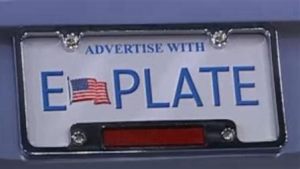 [Trivia Break! Recent demand in several U.S. states moved the license plate character count from six to seven. Guess how many unique plates you can make from a combination of three numbers and four letters alone? Sixteen million. It’s fair to say we won’t be needing an eighth license plate character anytime soon.]
I admit I’m slow to adopt new inventions, even though I spent the last twenty years of my career in tech. The laptop I’m typing on is five years old and doing just fine. The SUV I drive will last fifteen years since the one I had before it did as well. And the fitness band I wear gives me a dozen angles on my health yet I’m more interested in the time of day.
 Electronic license plates may be overcomplicating the issue. The metal variety sits there quietly, displaying letters and numbers like it’s supposed to. The electronic variety aims to be anything but a license plate. Amber Alerts. Insurance/registration violations. Product advertisements. Or – God forbid – electronic bumper stickers, where the owner can publicly express the kinds of opinions to drive the rest of us to road rage.
 Say what you will about BMW, but the automaker is simply climbing onboard the subscription bandwagon. Who can blame them for finding new ways to make (our) money? On the other hand, drivers may wake up one day and wonder why we ever caved to electronic license plates. We just have to glance at our roadside billboards to know we had it coming.
Some content sourced from Wikipedia, “the free encyclopedia”.
-
Food-and-Drink – Eternally Linked
In the proverbial question of the chicken or the egg, the operative word is or. One came first or the other came first – not both. Same with the game of chess; you choose to be the black or the white, not every piece on the board. And the song you selected this morning to begin your morning commute? It was one of your favorites, not two (unless you found a mashup). So it boggles my find to discover, at Costco of all places, you can have a hot dog and a soda… just not or. It’s food and drink – or it’s nothing at all.
 It’s been a while since I’ve shopped at Costco, so last Sunday’s visit felt like more than just a battle for space in the aisles. Featured items seemed new and interesting and the free samples beckoned more than usual. My wife and I go to Costco for paper goods, produce, wine, and not much else, so we made it to check-out sooner than most, but there was still a pretty good line of people. While we waited, I realized Costco is savvy with its store layout. Approaching the cashier, you face… the food court. On this day, the court was b-u-s-y, with just about every seat taken.
I never ever patronize the food court at Costco (I like to think I lean healthier) but something triggered my brain this time around. Just after July 4th a local radio host commented how “Costco hot dogs are the best, and believe me, I know hot dogs.” Suddenly a Costco hot dog sounded pretty good! So I asked my wife to stay in line while I pursued our spur-of-the-moment lunch. A lot of people were standing by the counters (looking nothing like a line) and I realized they were already waiting for orders. You see, at Costco you self-order on a computer screen – just touch the picture of the food or drink you want and insert a credit card.
Pepperoni pizza. Hot turkey and provolone sandwich. “Chicken bake”. Caesar salad. Hot dog and a soda. Ice cream. Those are pretty much your choices at Costco. The menu isn’t big and it’s certainly not your dietician’s recommendation, but it’s what the average Costco patron wants. Just not this patron. Not quite.
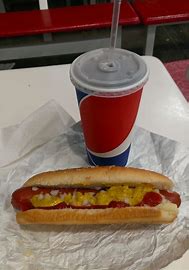
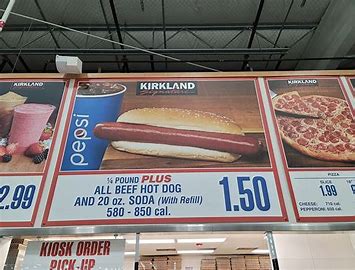
“Inseparable” You Costco regulars already know this. A hot dog and a 20 oz. soda at the food court is only $1.50. Always has been and purportedly always will be. But here’s the rub. The computer screen doesn’t offer a picture of a hot dog. You’ll only find a hot dog with a soda. But there’s also a soda without a hot dog. In what world of logic does this make sense? I want a hot dog, Costco sells hot dogs, but I can only have one if I buy a 20 oz. soda as well. But I don’t want a soda…
This quickly became a matter of principle (as you might expect). I mean, $1.50 is reasonable for a hot dog so why not just go for the combo and throw away the empty soda cup, right? Yeah, I wish it were that easy for me. I challenged a couple of Costco employees about it back in the checkout line, and both said, “That’s the way it’s always been. It’s a nod to tradition. They’ll never change the price and they’ll never unlink the hot dog and the soda”. When I pointed out that, hey, you could buy a soda on its own (but not a hot dog on its own), that made them pause. A little.
Scold me now, please. There’s a war going on in Eastern Europe. Food and gas prices are through the roof. The U.S. is experiencing one of its hottest summers in decades with states forced into rolling blackouts. Meanwhile, I’m pitching fits because I can’t buy a hot dog all by itself at Costco.
 Fittingly, you get the last laugh. My wife and I pulled out of the Costco parking lot and still had a taste for a hot dog, and the only place we could think of was a little sports bar in my mother-in-law’s neighborhood. So we go there and I order a hot dog with fries while my wife opts for the bratwurst with Tater Tots. (and yes, for those of you keeping score I could’ve ordered this hot dog all by itself). Then the cashier rings up the order and says, “That’ll be $30.00” (not $1,50, not $3.00 – thirty bucks). And how was my hot dog? Delicious, actually. I’d have the same thing again nex time. I just need to stop thinking about how I could’ve had twenty Costco hot dogs (and a bunch of empty soda cups) for the same price.
-
Floral Fire
Billboard ranks “Firework” as Katy Perry’s best-selling single, with millions of downloads since its 2010 release. The self-empowerment tune “skyrocketed” to #1 on Billboard’s Top 100 at the time and ranked in the top five on twenty other charts worldwide. “Firework” also “sparked” an award-winning music video, and Katy has since performed the anthem live at two presidential inaugurations and during the halftime show of the Super Bowl. Searching Wikipedia for “firework”, therefore, it comes as no surprise to be asked, “Do you mean the song or the low-explosive pyrotechnic device?” Today, I choose the latter.
 For the first time in countless July 4th celebrations I can’t speak to having seen a single overhead firework display this year. No giant “willows” with their graceful descending trails of sparks; no “peonies” where those same trails radiate in straight lines from the center; and no “horsetails” (my favorite) where each trail bursts a second time, followed by a crackling, glittering shower of fire. Also, no “grand finale” where it looks like the entire sky is splitting open to some fiery furnace beyond.
“Chrysanthemums” From the vantage point of our house, we used to count on the fireworks show from the nearby U.S. Air Force Academy. That show has been canceled for the last ten years because of budget cutbacks. We also used to bring blankets to the shore of a nearby lake, where we were treated to a “small-town” fireworks display funded by donations from the public. Today, that display has been swallowed up by a bigger all-day “Festival on the Fourth”, where you pay for parking and walk a mile or two just to secure a spot on the lake several hours ahead of the fireworks. Even so, we thought we’d see bits and bursts from one of the other nine shows scattered around nearby Colorado Springs. Nope, not so much as a snap, crackle, or pop.

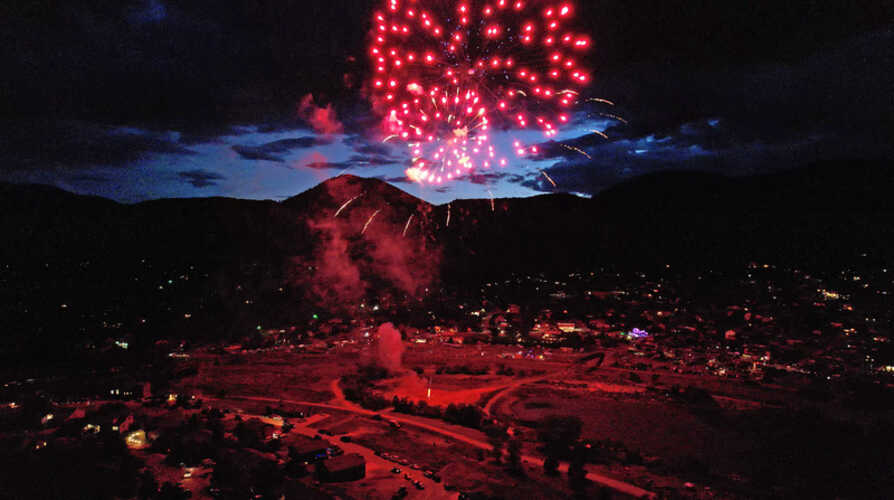
Palmer Lake, CO 2022 fireworks display (photo courtesy of local resident Bartley Willson) Fireworks are nostalgic for me, with two distinct memories from childhood. The first, in the 1970s, brings me back to the beach of the Pacific Ocean in Los Angeles. Back then the only commercial displays seemed to be over the ocean. My parents would grab a bucket of Kentucky Fried Chicken and several blankets, and the whole family would find a place on the beach where for several hours, we’d eat and play as twilight became dark, in anticipation of the late, late fireworks show from the end of the nearby pier.
The second memory, a decade later, also brings me to the Pacific Ocean but to a beach further south near San Diego, where we’d shoot off our own fireworks (from the “Safe and Sane” boxed collections my dad brought home every year), followed by an overhead display from the nearby county fair. Every childhood July 4th was the same: food, fun, and fireworks; lots and lots of fireworks.

“Waterfall” In 1976 – America’s bicentennial year – the firework display in New York City included an unforgettable “waterfall” effect off one of the bridges. This year, that same July 4th display (sponsored by Macy’s) ballooned to a two-hour televised extravaganza with over 2,000 blasts and effects per minute. I’d say Macy’s department stores and their profit margins are doing just fine, wouldn’t you?
I shouldn’t be surprised to learn fireworks were invented by the Chinese (well over a thousand years ago) but here’s a less-obvious bit of floral fire trivia: Disney is the largest consumer of fireworks in the world. It used to be – back when their single amusement park was California’s “Disneyland” – you’d only catch a Disney firework show on summer evenings (directly above Cinderella’s castle), and only if you stayed until just before the park closed. Today you’ll find displays at any one of the twelve Disney parks, in any month of the year. For the record, only the U.S. Department of Defense purchases more explosive devices than Disney.
 There’s more firework trivia, of course. The very first iterations were empty bamboo shoots, creating a mild popping sound when ignited because of natural air pockets. Seeking more pyrotechnics, the Chinese added explosive chemicals to the shoots to create firecrackers”. Eventually they figured out how to launch and propel their creations, and the overhead fireworks display was born, in an impressive rainbow of chemical colors. But take note; you won’t see a blue firework very often. Blue requires an infusion of copper at just the right temperature, and the “cool” color tends to get lost next to the “hotter” reds and yellows.
“Catherine wheels” I’m still puzzled why I didn’t hear so much as a “BOOM! BOOM! BOOM” aftershock (to quote Katy Perry) of a firework display this year. Maybe most of my fellow Coloradoans kept the bursts and blasts to the ground instead, from what they purchased at the local firework stand. Those of you living in New Jersey, Massachusetts, or Delaware can’t relate because consumer fireworks are illegal in your states. Not so much as a sparkler in your hand. (Which may be a good thing since sparklers can heat up to 2000 ºF) So you probably did what I did this year – simply watch a recap of the Washington D.C. grand finale on your smartphone. It was the only floral fire I could find.
Some content sourced from the BuzzFeed article, “17 Things You Probably Never Knew About Fireworks”, the Macy’s Fourth of July Fireworks website, and Wikipedia, “the free encyclopedia”.
-
Many Happy Returns
Unlike 2021, the due date for U.S. tax returns was back to mid-April this year. Most of us sweated under the ticking clock as we combed through statements and receipts in search of last-minute tax breaks. I have this recurring pipe dream where the IRS tells me to just keep what I owe (followed by the dream of how I would spend the money). Sadly, I’m a taxpayer who rarely sees a refund, and keeping what I owe certainly won’t happen. On the other hand, retailers could soon be asking me to keep what I want to return. Now there’s something to ponder.
 Picture this. You place an Amazon order for a brand new Playstation 5. You plunk down the $500 it costs and a few days later your purchase shows up on your doorstep. But while you were waiting for your gaming console the IRS sent you a reminder about the balance due on your 2021 taxes. Whoops. You owe that $500 to the federal government, young taxpayer. Hello, buyer’s remorse. Full of regret, you contact Amazon to arrange the return, and their carefully worded response goes like this:
Dear Amazon Prime Member. Thank you for your inquiry into the return of your Playstation 5 gaming console. After reviewing our current stock we have determined it is not necessary for you to return this product. Accordingly, nothing further is required at this time. You can expect a full refund applied to the credit card used to make this purchase. Thank you for shopping with Amazon.
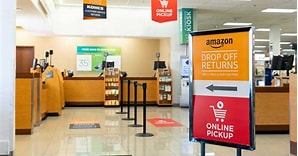 Wait… keep the product AND get a refund, you say? Crazy, I know. Or maybe not, at least if you shop at Target or Wal*Mart. Both retailers are considering this no-return approach with clothes, garden furniture, and “bulky” kids’ toys among other products they currently overstock. It’s the result of consecutive worldwide events. First, the pandemic, which allowed consumers to build up their savings accounts while mostly staying at home. Second, record-setting inflation, which dragged a knife through what was supposed to be a post-pandemic spending frenzy. Retailers stocked up early in anticipation of the purchase party, but then the lights and music were abruptly cut off. The result: overstocked with a capital “O”.
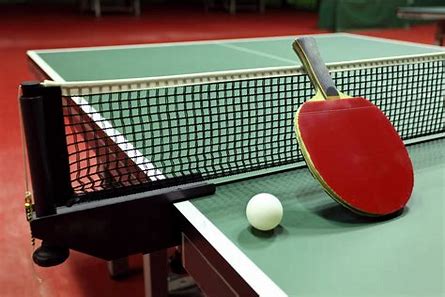
 This version of keep-the-product-keep-the-cash kinda-sorta happened to me years ago. My sister-in-law ordered a ping-pong table for her family and when it came, they discovered a bit of damage in one corner. So she contacted the company, who told her, “Keep it. We’ll just send you another one.” Thus, in a moment labeled “Christmas not on Christmas”, my family got a free ping-pong table (Thanks, Sis!) Sure, the bounce of the ball was a little off on that one corner, but my kids didn’t care. Besides, before I knew it they were old enough (or not) to drink and pretty much destroyed the table when they shifted to beer pong.
But I digress. With a ping-pong table I’m almost sure the cost of shipping back to the manufacturer was more than the profit after fixing and reselling it. So my sister-in-law got two tables for the price of one. Hey, what if she’d bought ten ping-pong tables and all of them were defective? She’d go up and down her street handing out free tables. She’d gain a bunch of new best friends and her neighborhood would hold massive ping-pong tournaments. All for the cost of one table.
 The problem at Target and Wal*Mart is more than just the cost of returns and overstocked items. It’s also, they can’t charge the same price they charged you. For one, the item may be offered at a discounted price by the time you return it. For two, certain items have to be classified as “used” and can’t be offered at full price after the first purchase, or even offered at all.
“Un-resellable” Which brings me to orange juice. Orange juice, you ask? Yep. Try to return a jug of juice to the market some time. We bought five jugs a couple of months ago for our daughter’s bridal shower, assuming the mimosas would flow like Niagara Falls. Wrong. Only a few of the guests opted for the bubbly since the shower was mid-day. So I called my local market to confirm the return of four unopened jugs of juice, and was horrified to hear, “Sure, you can return them for a full refund. But we’ll just throw out the juice.” Throw out the juice? Yes, it’s the world we live in these days. Many food items cannot be resold for fear of tainting. So I’m drinking a lot of orange juice right now.
 Let’s wrap this public service announcement with a caveat. One of these days you’ll be pleasantly surprised when you end up with a purchased product AND a full refund. Lucky you – it’s “Christmas not on Christmas”! If it’s through Amazon, however, be wary of the following purchases: hazardous materials, gift cards, jewelry, groceries, and live insects (uh, live insects?) None of those can ever be returned, nor will you get your money back. In other words, the sea monkeys you adopted in a moment of nostalgia (remember those, Boomers?) should be considered bought and paid for. No refunds.
Some content sourced from the CNN Business article, “Just keep your returns…”, and the Clark.com article, “12 Items That Can’t Be Returned to Amazon”.












About Me
The sky is not completely dark at night. Were the sky absolutely dark, one would not be able to see the silhouette of an object against the sky.
Follow Me On
Subscribe To My Newsletter
Subscribe for new travel stories and exclusive content.
 Life In A Word